
.

Copyrights

Google v. Oracle: SCOTUS Sides with Google on Fair Use, But Is The Ruling Narrower Than It Seems?

April 19, 2021

by Connor J. Hansen and Stefan Szpajda

Download as a PDF

Share this page

On April 5, 2021, the Supreme Court issued its decision in Google v. Oracle, ruling 6-2 in Google’s favor on the issue of fair use. So ends a decade-plus battle between two tech giants that many viewed as having the potential to reshape how computer programs are written and licensed across the software industry. Google’s win—which is plainly indebted to the amici curiae who persuaded the Court of the policy rationale for a finding of fair use—thrilled those who saw a potential win by Oracle as an existential threat to settled norms in the software industry. Others have received the decision with skepticism, questioning how the Court could have blessed Google’s verbatim copying of Oracle’s code and struggling to reconcile the result with the plain text of the Copyright Act and established fair use precedent. Now, as the dust settles, those looking to Google v. Oracle for guidance on what they can and can’t do with proprietary software they don’t own must decide what, if anything, they can draw from its holding. The answer may prove elusive, and expensive.

We’ve followed this story since the Court first granted certiorari in 2019, with posts laying out the questions before the Justices, analyzing copyrightability and fair use, and summarizing oral argument. (For those new to the subject matter, these earlier posts will help you get up to speed on this complex case.) Now, in our final post in this series, we turn to the result.

Holding

Noting that Google v. Oracle does not “overturn or modify” earlier cases involving fair use, the Court held that Google’s re-implementation of a “user interface” (i.e., 11,500 lines of declaring code from 37 Java API libraries) owned by Oracle was a fair use of that material as a matter of law.

Justice Breyer wrote the majority opinion, joined by Justices Roberts, Sotomayor, Kagan, Gorsuch, and Kavanaugh. Justice Thomas dissented, joined by Justice Alito. Justice Barrett took no part in the decision.

The Majority Opinion

Although there were two questions before the Court, the majority ignored the first, making no express ruling on whether the declaring code at issue is copyrightable. As discussed below, this omission drew sharp criticism from the dissent, and is likely to exacerbate uncertainty over how the holding in Google v. Oracle should be applied. That said, the Court implicitly sided with Oracle on this question as fair use only comes into play if the underlying work is subject to copyright; the majority also acknowledged in several places that computer programs, including the declaring code at issue here, are “subjects of copyright.” This acknowledgement, however, only makes the majority’s silence on the first question before it more conspicuous and puzzling.

Instead of addressing copyrightability under 17 U.S.C. §§ 101 and 102, the majority devotes its opinion to an analysis of the fair use factors enumerated under 17 U.S.C. § 107, ultimately ruling that each one favors Google.

Factor 2: “The Nature of the Copyright Work.” Although this factor is actually the second fair use factor, for “expository purposes” the majority considered it first.

Under this factor, the majority compared declaring code and implementing code, and identified the attributes of declaring code that distinguish it from implementing code and—per the majority—weaken its protection under the Copyright Act. For example:

  • declaring code is “inextricably bound together” with the division of computing tasks that “no one claims is a proper subject of copyright;”
  • declaring code is “inextricably bound up” with the idea of organizing tasks in a manner that is not copyrightable;
  • declaring code is “inextricably bound up” with the use of commands, i.e., method calls, that Oracle did not claim were copyrightable; and
  • declaring code is “inextricably bound up” with implementing code, which Google did not copy from Oracle.

Although these observations were all made in the context of fair use, they track the arguments Google raised in objecting to the copyrightability of declaring code under the first issue before the Court. This, again, puts a spotlight on the majority’s decision to ignore the first issue before it, and invites the question of why it didn’t simply make these observations in that context. (More on that in our discussion of the dissent.) Further elaborating on the distinction between declaring code and implementing code, the majority concludes that declaring code “embodies a different kind of creativity” in that Oracle’s code was written to attract programmers by making it easy to remember and use.

Putting these ideas together, the majority observed that although both declaring code and implementing code are “functional in nature,” declaring code is “inherently bound together” with (1) uncopyrightable ideas (task division and organization) and (2) others’ new creative expressions, like Google’s Android implementing code. The majority thus ruled that the nature of declaring code weighs in favor of fair use.

Factor 1: “The Purpose and Character of the Use.” Here the majority considered whether Google’s use added “something new, with a further purpose or different character,” altering Oracle’s declaring code. First addressing traditional concepts derived from precedent to consider whether the use was “transformative” under this factor, the majority acknowledged that Google precisely copied the code at issue, and used it “in part” for the same purpose as Oracle. This would typically cut against Google, but the majority added that, in the context of computer programs, those cannot be reasons to rule against fair use because it would improperly limit the doctrine of fair use. Thus, the majority decided that Google’s purpose was to use declaring code created for use in desktop and laptop computers and apply it to smartphones. Although the majority stopped short of ruling that all such re-implementation of declaring code will weigh in favor of fair use under this factor, it observed that the record demonstrates that re-implementing declaring code in this manner “can further the development of computer programs.” In advancing this view, the majority cited the contributions of amici supporting Google, referencing briefs submitted by Copyright Scholars, Microsoft, Computer Scientists, R Street Institute, and American Antitrust Institute. The amici convinced the majority that Google’s use was transformative under this factor.

The majority also considered the commerciality and good faith of Google’s use, finding that Google’s commercial use was not dispositive in light of its “inherently transformative” use, and expressed skepticism regarding the role Google’s alleged bad faith should play in the analysis, choosing to give it no weight. The majority found this factor weighed in Google’s favor.

Factor 3: “The Amount and Substantiality of the Portion Used.” Google copied the declaring code for 37 packages of the Sun Java API, totaling approximately 11,500 lines of code. If considered in isolation, the majority acknowledged that would be a lot of copying. But the majority declined to consider it in isolation, and instead took into account the several million lines that Google did not copy in ruling that this factor weighed in Google’s favor.

Factor 4: “Market Effects.” Here, the majority declined to consider the market effects of Google’s copying by looking at the revenue Oracle lost as a result. Instead, the majority stressed Oracle’s poor position for success in the smartphone market, and weighed it against Oracle’s claim that Google’s copying harmed it. The majority also took into account whether Google’s copying produced “public benefits” related to the Copyright Act’s concern for the “creative production of new expression.” Significantly, the majority noted that a weighing of public benefit may not always be relevant, “not even in the world of computer programs.” But it nonetheless decided to weigh them here in determining the likely market effects of Google’s re-implementation.

Somewhat confusingly, in ruling against Oracle on this factor the majority reasoned that the success of a computer program may initially be attributable to its expressive qualities, but that over time it can instead become valuable “because users, including programmers, are just used to it.” Oracle had previously warned that a ruling in Google’s favor would effectively punish it for Java’s success. And although that may be a reductive summary of the decision overall, the majority’s reasoning here raises questions as to when the success of a copyrighted work shifts from its expressive qualities to the inertia arising from wide adoption, and why that should reduce its protection under the Copyright Act. Those wondering will find little comfort in the majority’s conclusion that “given programmers’ investment in learning the Sun Java API, to allow enforcement of Oracle’s copyright here would risk harm to the public.”

The Dissent

The dissent wasted no time before taking the majority to task for its failure to address the first question before the Court, i.e., whether declaring code is copyrightable. Noting that the majority “purports to assume, without deciding, that the code is protected,” the dissent concluded that the majority’s fair use analysis is “wholly inconsistent with the substantial protection Congress gave to computer code.” The implication here is that the majority sidestepped the first question because, had it fleshed out its position, the reasoning would have made its fair use analysis untenable. Per the dissent, “the majority purports to save for another day the question whether declaring code is copyrightable” because it “cannot square its fundamentally flawed fair-use analysis with a finding that declaring code is copyrightable.”

As to the nature of the work, the dissent rejected the majority’s attempt to distinguish implementing code from declaring code, noting that each observation made by the majority about implementing code is equally true of declaring code. The dissent added that “it makes no difference” that the value of declaring code depends on how much time third parties invest in learning it because “[m]any other copyrighted works depend on the same.” The dissent illustrates this point by analogy, explaining that although a Broadway musical script needs actors and singers to invest time learning and rehearsing it “a theater cannot copy a script—the rights to which are held by a smaller theater—simply because it wants to entice actors to switch theaters and because copying the script is more efficient than requiring the actors to learn a new one.”

The dissent also took a sharply different view of the market effects of Google’s copying, noting that whether or not Oracle could have built a smartphone on its own is only “half the picture” because Oracle could have licensed its software for use in Android. According to the dissent, Google’s copying destroyed that market for Oracle: “By copying Oracle’s work, Google decimated Oracle’s market and created a mobile operating system now in over 2.5 billion actively used devices, earning tens of billions of dollars every year. If these effects on Oracle’s potential market favor Google, something is very wrong with our fair use analysis.”

On the nature of Google’s use, the dissent accused the majority of conflating transformative use with derivative use, stressing that by the majority’s logic a movie studio’s unlicensed creation of a film based on a book would be transformative.

Finally, the dissent would find Google’s use substantial because it could serve as a “market substitute” for the original.

At bottom, the dissent rejects the majority’s view that there is a sufficient difference between implementing code and declaring code to render the former more protectable than the latter. The result of the Court’s ruling, per the dissent, is that it is now “difficult to imagine any circumstance in which declaring code will remain protected by copyright.”

Standard of Review

Many observers were surprised when, in 2018, the Federal Circuit reversed the jury’s 2016 finding of fair use, and Google argued that the appellate court applied the wrong standard of review by failing to give appropriate deference to the jury’s findings of fact. Google went so far as to argue that the Federal Circuit violated the Seventh Amendment’s right to a trial by jury, which raised eyebrows when it spurred a request for supplemental briefing from the Court.

But on these procedural questions, both the majority and dissent agreed with Oracle that the Federal Circuit applied the correct standard when it treated fair use as a mixed question fact of law. The Court held that appellate courts should defer to the jury on findings of underlying fact, and then consider de novo whether those facts support fair use. Although it made no difference to the outcome here, the Court’s ruling on these questions injects more uncertainty into future litigation by making appeals from a jury’s findings on fair use more viable than they would be had the Court sided with Google on this issue.

Where Do We Go From Here?

It is tempting to view the Court’s ruling as a clear win for software developers who want to re-implement portions of proprietary computer programs without a license—i.e., much of the software industry. But the holding may prove narrower and more uncertain than it appears. That’s because any fair use analysis necessarily mixes questions of fact and law, and is often—by design—uncertain. Indeed, the majority in Google v. Oracle stressed the doctrine’s “flexible” approach to the “sometimes conflicting” aims of copyright law, and that “its application may well vary depending upon context.”

With the above in mind, consider the meandering path Google’s fair use defense took in this case. During the first trial in 2012, the jury deadlocked on fair use. In 2016, after a second trial on fair use, the jury found for Google. Then, in a rare move, the Federal Circuit reversed the jury’s finding and ruled that only one of four factors favored Google, with two of the four strongly or heavily favoring Oracle. Now, in 2021, the Supreme Court has ruled that the 2016 jury got it right, not only reversing the Federal Circuit but holding that every single fair use factor favored Google. The dissent, examining the same facts, found only one factor favored Google.

In addition, as illustrated in the chart below, the many amici who weighed in were split across factors. 39 amici addressed at least one fair use factor, but very few of the 39 addressed each of the four factors. The first factor was the most addressed factor, with 31 amici offering arguments relating to the purpose of the use, followed by the fourth factor with 26 amici addressing market effects. Although more amici argued in favor of Oracle for each of the fair use factors, the amici who argued for Google generally provided a deeper analysis of the issues relevant to fair use. This is because most Oracle-supporting amici who addressed fair use also addressed copyrightability, whereas many Google-supporting amici who addressed fair use devoted their entire briefs to fair use. Google-supporting amici also tended to focus on fewer factors, often just one or two factors, whereas Oracle-supporting amici tended to address three, if not all four, of the fair use factors. And the majority was clearly persuaded by Google-supporting amici, as it cited several of their briefs in its opinion.
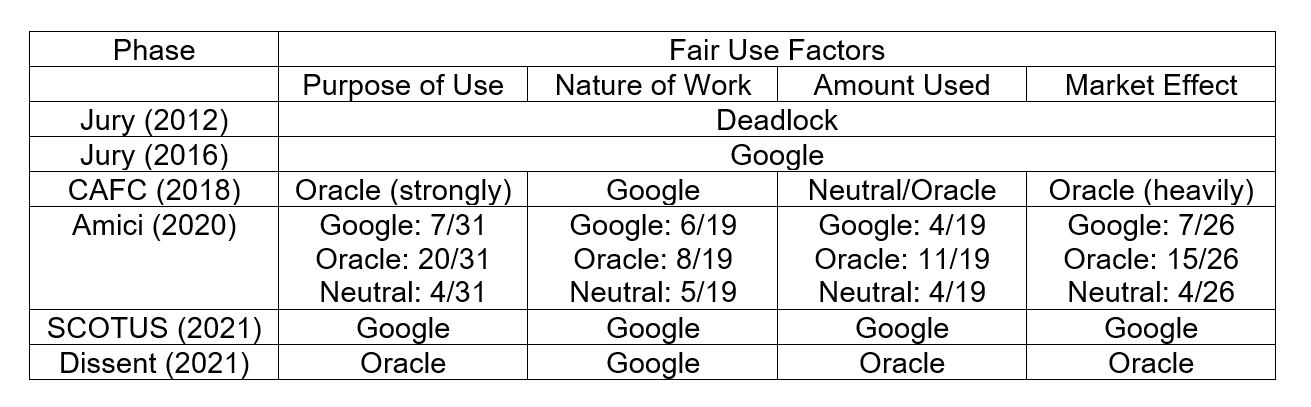
Now imagine you’re a software developer who must decide whether Google v. Oracle clears the way for you to use another company’s proprietary code. How do you determine whether the code at issue is more like implementing code, which the Court did not include in its ruling on fair use, or declaring code? And assuming you can determine that the code is like the declaring code here, do you look at the result—the Court ultimately found fair use, and resoundingly so—and find comfort to proceed without a license? Or does the expensive and uncertain path of a fair use defense make you hesitant to take on that risk? After all, like Google, you may prevail, but the victory may cost more in legal fees than a license would have. Or, you might lose outright because the highly factual analysis cuts against you. For example, a court might find that your use of the code did not result in a sufficiently successful product to warrant a finding of fair use under Google v. Oracle, or that the code’s owner is better placed to compete in your market than Oracle was to compete in the smartphone market, and rule against you on that basis. Moreover, it should not be lost on anyone that Google spent many millions in legal fees, and the collective investment by the amici who filed briefs in support of Google was also significant. Query whether the same result would have been possible for a litigant without such resources to spare.

At best, in situations where the code in question is closely analogous to the declaring code at issue in Google v. Oracle, the Court’s ruling may support an efficient resolution finding fair use. But the line between implementing code and declaring code in Java—not to mention its analogues in other programming languages—may prove difficult to draw. And in those situations, Google v. Oracle is unlikely to provide the sort of certainty that can lead to efficient resolutions of copyright disputes.

Conclusion

The Court ruled that, under the doctrine of fair use, Google was free to use 11,500 lines of code from 37 Java API libraries owned by Oracle when Google programmed its Android platform. For Google, this means it will not be liable for potentially billions of dollars in damages. What it means for everyone else remains to be seen, and in light of the fact-intensive and context-specific premises behind the Court's ruling Google v. Oracle may prove narrower than it first appears.

Firm Highlights

News

Real Estate Attorney Alexis Olsen Joins Dorsey in Phoenix

Attorney Alexis Olsen has joined Dorsey & Whitney LLP as Of Counsel in the Real Estate group in Phoenix, the law firm announced today. Alexis focuses her practice on large-scale residential, mixed-use, and multi-asset development projects as well as multi-state commercial leasing transactions. She guides clients through sophisticated acquisitions, dispositions, leasing, entity structuring, investment strategies, and due diligence matters. She has structured co-investment arrangements that drive capital deployment into housing subdivisions nationwide and has represented both landlords and tenants in commercial leasing transactions involving office, retail, industrial, and specialty-use properties, including cannabis dispensaries. Alexis received her J.D. from Sandra Day O’Connor College of Law and her B.A. from the University of Arizona. Alexis comes to Dorsey from Squire Patton Boggs. “Alexis strengthens Dorsey’s real estate capabilities at a time when Phoenix remains one of the fastest-growing and most dynamic real estate markets in the country,” said Scott Jenkins, Dorsey’s Phoenix office head. “Her addition further enhances our deep bench of 12 real estate attorneys in Phoenix and reflects our continued investment in serving clients throughout Arizona and supporting their real estate transactions and objectives across the country. We are thrilled to welcome Alexis to Dorsey.” “Joining a firm with such a deep bench of experienced attorneys in the Phoenix office, especially in the Real Estate group, presents an exciting opportunity not just for my own professional growth, but for the clients we service,” said Alexis Olsen. “I look forward to building on this strong foundation, growing our national practice, and delivering top-tier service to our clients.”

Insights

Proposed CMS Rule Ramps Up Potential Medicare Fraud Administrative Remedies

On July 6, 2026, the Centers for Medicare & Medicaid Services (“CMS”) proposed a rule that would expand its administrative remedies to combat potential fraud. The proposed rule is the latest in a round of administrative actions that signal CMS’s intent to aggressively pursue allegations of Medicare and Medicaid fraud and heighten the risk of fraud enforcement against even well-intentioned Medicare and Medicaid providers and suppliers. The proposed rule includes several changes to regulations that govern Medicare billing privileges. Providers and suppliers should be aware that these changes dramatically expand the flexibility afforded to CMS in enrollment and revocation actions, potentially leading to harsh consequences for ministerial and administrative errors. If finalized, moreover, the proposed rule could have material implications for providers and suppliers facing threatened revocation, including heightened risk of overpayment liability and increased hurdles to challenging revocations and denials of enrollment. Added Flexibility to Existing Revocation Grounds CMS has proposed to remove a number of factors that the regulations list as relevant to a determination of whether a provider has engaged in “abuse of billing privileges.” While acknowledging that the inclusion of these factors in the regulations was permissive (requiring consideration only where “as appropriate or applicable”), CMS stated that it must be afforded “the maximum flexibility to address all possible . . . scenarios without the rigid constraints of our existing factors.” CMS provided little guidance as to the outer bounds of what conduct could constitute an “abuse of privileges” that merits revocation of Medicare billing privileges. Instead, CMS noted that a “pattern of practice” of abuse of billing privileges might be established “by a simple finding that several of a provider’s claims do not meet Medicare requirements.” Similarly, CMS has proposed to expand the regulatory provision that permits revocation of enrollment if a provider certifies as “true” false or misleading information in Medicare enrollment application or renewal forms to include any scenario in which a provider submits “false or misleading information on or associated with any CMS Medicare enrollment-related form,” including materials submitted to Medicare contractors. CMS stated that it interprets this expanded rule to include anything related to Medicare enrollment, and not only those submissions that are “intended to gain or maintain Medicare enrollment.” If finalized, the proposed rule would add significant flexibility to CMS’s ability to pursue revocation of a provider’s enrollment. While CMS has assured providers that it would “invoke [the revised regulations]. . . only when legitimately warranted under the facts and circumstances and not as a matter of course,” such expanded flexibility threatens unpredictability in the event of even administrative or ministerial errors in submissions and claims. These changes would, moreover, make it more difficult for providers to challenge a revocation action. Expanded Revocation Grounds In addition to adding flexibility to existing grounds for revocation, CMS’s proposed rule adds to and expands CMS’s already broad authority to revoke provider and supplier enrollment. Such proposed changes include adding the following grounds for revocation: Denial of Enrollment Application. Where CMS could previously revoke a provider’s other enrollments if one enrollment is revoked, CMS would also be able to revoke a provider’s existing enrollments if an application for enrollment submitted by the provider is denied. High-Risk Enrollments. CMS would be able to revoke enrollment if it determines the provider or supplier (including owning/managing employees or organizations) poses a high risk of fraud, waste, or abuse due to “. . . an affiliation under [42 C.F.R.] § 424.519” or “the provider’s or supplier’s location within a limited geographic area that has an excessive number of providers and suppliers.” Certain Misdemeanor Convictions. CMS would be able to revoke enrollment if a provider or supplier—or its owners, managing employees, managing organizations, officers, or directors—are convicted of a “misdemeanor related to sexual assault or financial misconduct within the past 10 years that CMS deems detrimental to the best interests of the Medicare program and its beneficiaries.” Ownership Changes (HHA, Hospice, DMEPOS). CMS would have broad authority to revoke enrollment of home health agencies, hospices, and DMEPOS suppliers who do not comply with the regulations governing provider changes of ownership. These proposed, expanded grounds for revocation are notably broad, and CMS provides only limited guidance as to what conduct might result in revocation under these grounds. As with the proposed expansion of existing grounds for revocation, the open-ended nature of these proposed grounds for revocation may make it more difficult for providers and suppliers to challenge revocation actions. Expanded Grounds to Deny Medicare Enrollment As with revocations, CMS proposes to expand the grounds under which a provider’s application to enroll in Medicare can be denied. These expanded and additional grounds include many of the grounds added for revocations, but also include: Medicare Debt or Payment Suspension. CMS proposes expanding the ground to deny enrollment based on Medicare debt or payment suspension to include a provider or supplier’s “managing employee, managing organization, or individual or entity with any other form of business or financial relationship with the provider or supplier[.]” Significantly, this expansive definition (called an “associated party” under the proposed regulation) currently contains no material limitations, meaning almost any person or entity with whom an applicant does business could create denial liability. Sharing Locations with Denied/Revoked Providers or Suppliers. CMS would have authority to deny applications where a “provider’s or supplier’s practice location is in the same suite or office as another provider or supplier whose Medicare enrollment has been revoked or denied.” Hospices with Distant Medical Directors or Administrators. CMS would have discretion to deny hospice applications if the hospice’s medical director or administrator serves “multiple other hospices” or practices/is located “at such a distance (for example, in a different state) from the enrolling hospice that the medical director cannot realistically perform all medical director functions,” with a similar provision for administrators. In addition, CMS proposes applications denied for “other program termination or suspension,” may be applied to the provider or supplier in its own name or NPI or that of its owners, managing employees, or managing organization regardless of whether any appeals are pending. Retroactive Revocation CMS proposed to restructure and expand the regulatory grounds for retroactive revocation of billing privileges. Currently, Medicare regulations provide that revocations are, by default, prospective in nature: effective 30 days after CMS or the CMS contractor mails notice to the provider. Under certain circumstances, the regulations provide for revocations to be retroactive, such as when a provider is convicted of a felony, the date a professional license is suspended, revoked, or surrendered, or when a provider submits a false certification in their enrollment application. CMS has proposed to reframe the rule so as to default to retroactive revocation of billing privileges. CMS expressed concern that providers may collect payment from Medicare while remaining so non-compliant with enrollment requirements as to merit revocation. To address this concern, CMS proposed that all revocations be retroactive to the date of determined non-compliance.[1] As a result, providers suspected of misconduct or non-compliance are likely to face claims of retroactive overpayments in addition to the immediate concern no longer receiving Medicare payments while their enrollment is revoked. Reapplication Bar CMS’s proposed rule expands the grounds from which a provider may be prohibited from seeking reapplication as a Medicare provider. Under current regulations, CMS may prohibit prospective providers from enrolling in Medicare for up to 10 years if its enrollment application is denied because the applicant submitted false or misleading information in its application. Under the proposed rule, CMS will have the discretion to prohibit a provider from enrolling in Medicare if their enrollment application is denied for any reason. Conclusion As a part of the federal government’s increasingly aggressive push to combat real or perceived healthcare fraud, the proposed rule both broadens CMS’s authority to revoke and deny Medicare enrollment and raises the stakes for revocation and denial. What the proposed rule does not share is how CMS plans to exercise this expanded discretion: as a result, the proposed rule, if enacted, increases the unpredictability and potential ramifications of even technical noncompliance with CMS rules. As a result, Medicare providers should keep a close eye on potential revisions to these rules and their potential implementation and consider proactively evaluating their compliance under CMS standards. [1] In the proposed rule, CMS identifies, with respect to each ground for revocation, what it will consider to be the effective date of revocation.

News

37 Dorsey Attorneys Named 2026 Top Lawyers by Minnesota Monthly

Minnesota Monthly has recognized 37 Dorsey attorneys across 27 practice areas as 2026 Top Lawyers in Minnesota. Honorees are selected through a peer nomination process and a curated survey of practicing attorneys in Minnesota, who identify leading lawyers across a range of practice areas. Administrative / Regulatory Law Jennifer Coates Antitrust Law Michael Lindsay Banking & Financial Service Law Peter Nelson Copyright Law  Jeffrey Cadwell Corporate Law  Robert Hensley Robert Rosenbaum Criminal Defense: White-Collar  Beth Forsythe Edward Magarian RJ Zayed Health Care Law  Claire Topp Immigration Law  J. Mike Sevilla Insurance Law  Daniel Brown Intellectual Property and Patent Law  Stuart Hemphill International Trade Law  Jonathan Van Horn Labor and Employment Law  Edward Magarian Ryan Mick Melissa Raphan Land Use & Zoning  Jay Lindgren Marcus Mollison Litigation – Antitrust  Michael Lindsay F. Matthew Ralph Jaime Stilson Litigation – Commercial  Michael Lindsay Litigation – Construction  Eric Ruzicka Litigation – Intellectual Property  Peter Lancaster RJ Zayed Litigation – Labor Employment Benefits  Ryan Mick Melissa Raphan Litigation – Trusts and Estates  William J. Berens Theresa Bevilacqua Bridget Logstrom Koci Mass Tort Litigation / Class Actions  James K. Langdon Mergers & Acquisitions Law  Keith Ahlgren Rachel Benedict Brian Burke Morgan Helme John Jorgenson Brian Moore Robert Rosenbaum Jonathan Van Horn Bri Whiting Municipal Law Jay Lindgren Nonprofit/Charities Law Claire Topp Securities / Capital Markets Law Cam Hoang Robert Rosenbaum Securities Regulation Theresa Bevilacqua James K. Langdon Tax Law William J. Berens Trusts and Estates Jennifer Ede Bridget Logstrom Koci Sonny Miller Kiley Petty Henry

News

Dorsey Partner Melissa Raphan Elected a Fellow of the College of Labor & Employment Lawyers

International law firm Dorsey & Whitney LLP is pleased to announce that Partner Melissa Raphan has been elected a Fellow of the College of Labor & Employment Lawyers (CLEL) as part of its 2026 class. “Melissa’s election to this prestigious fellowship comes as no surprise to those of us who have had the privilege of working with her,” says Peter Nelson, Dorsey’s Managing Partner.  “She is an exceptional employment lawyer, a trusted advisor, and a leader whose impact extends far beyond her matters. Clients rely on her deep knowledge, strategic counsel, and ability to navigate complex workplace disputes and sensitive employment matters with both confidence and compassion. She has helped shape our firm, strengthen our profession, and opened doors for countless others through her commitment to mentorship and diversity. We are incredibly proud of her accomplishments and delighted to see her receive this recognition.” CLEL is a nonprofit professional association that honors the nation’s leading attorneys in the field of labor and employment law. Originally established to recognize excellence in the profession, CLEL has evolved into a respected intellectual and practical resource for the legal community and its many audiences. Its mission centers on recognizing individuals who have made significant contributions to the field, fostering the exchange of knowledge and delivering value to academia, government, the judiciary, and the broader public. Election as a fellow represents the highest level of peer acknowledgment, reflecting sustained achievement, integrity, and a commitment to advancing the profession. Melissa’s career reflects CLEL’s mission. She has been recognized both regionally and nationally for her advocacy, leadership, and achievements both inside and outside of the courtroom. Her employment litigation experience spans class actions, collective actions, and high-stakes individual disputes in state and federal courts, as well as arbitration forums including the American Arbitration Association and the Financial Industry Regulatory Authority (FINRA). She is also a trusted advisor on a full range of workplace issues, from hiring and performance management to sensitive terminations and organizational change. She brings decades of experience representing clients across the financial services, healthcare, food and agriculture, and energy sectors. Melissa will be formally inducted during CLEL’s installation ceremony held in conjunction with the American Bar Association’s Labor & Employment Law Conference in Washington, D.C., on November 7.

News

Patent Partners Al Araiza and Lena Petrovic Join Dorsey in Palo Alto

Patent partners Al Araiza and Lena Petrovic have joined Dorsey & Whitney LLP in Palo Alto, the international law firm announced today. Al Araiza works with clients to develop and implement patent strategies that align with corporate objectives, supporting growth initiatives, financing efforts, and successful exits, including initial public offerings and acquisitions. He advises on building, managing, and optimizing patent portfolios across a broad range of emerging and frontier technologies, with depth in wireless communications, artificial intelligence, and energy innovation. Before practicing law, Al gained engineering experience in the defense industry, working on energy system modeling and communications circuitry design. He also conducted biomedical research, with findings published in peer-reviewed journals. He has been recognized in the IAM Patent 1000 for his work advising clients on patent strategy and portfolio development. Al received his J.D. from Duke University School of Law, his M.E. in Biomedical Engineering from Tulane University, and his B.S. in Electrical Engineering from UCLA. Lena Petrovic works across the software and hardware industries to develop clear, well-supported patent applications. She guides clients through the prosecution process and advises on global trademark and copyright matters, including licensing and portfolio management. Lena regularly supports clients developing technologies such as artificial intelligence and machine learning, fintech, cryptography, interactive and immersive experiences, and digital media, and works with companies in entertainment, gaming, and sports. Before practicing law, Lena spent a decade at Pixar, where she contributed to major films including The Incredibles, Ratatouille, WALL‑E, and Brave. Lena received her J.D. from Santa Clara University School of Law, her M.S. in Computer Science from Princeton University, and her B.S. from California Institute of Technology. “Al and Lena bring a practical, technical, and business-focused approach informed by extensive experience working with technology companies, startups, and investors,” said Gina Cornelio, Patent Practice Group Co-Leader. “We are thrilled to welcome them to the Patent team and our growing Palo Alto office.” “Dorsey’s Patent practice is dedicated to understanding each client's business deeply, tailoring patent strategies that directly advance their goals,” said Al Araiza. “We are proud to join this outstanding team and look forward to driving success for our clients.”

Insights

Litigation Privilege Does Not Automatically Protect Communications with Funders: The Commercial Court Clarifies the Limits of Privilege in the Context of Litigation Funding

In Uber London Ltd & Ors v Garry White & Ors; Mishcon de Reya LLP [2026] EWHC 1610 (Comm), the Commercial Court held that documents created to help a funder decide whether to invest in a claim will not ordinarily attract litigation privilege. This means that information a firm gathers while acting for a funder can later fall within the control of the claimants it goes on to represent in the same matter. Background The Claimants (a claim group of over 10,000 individual London black cab drivers and the assignee of two former minicab operators) alleged that the Defendants (three companies in the Uber group) obtained and retained their private hire operator's licence through an unlawful means conspiracy alleged to involve fraud. Because the claims were issued outside the ordinary six-year limitation period, the Claimants relied on section 32 of the Limitation Act 1980, contending they could not, with reasonable diligence, have discovered the fraud before June 2018. A preliminary issue trial was listed to determine the question of whether the Claimants discovered, or could have discovered with reasonable diligence, the alleged fraud and/or deliberate concealment only after June 2018. The Claimants were represented by Mishcon de Reya ("MdR"). However, before MdR’s engagement with the individual drivers had begun, in late 2017 it was engaged by the litigation funder Harbour to investigate the merits and value of the potential claim. During that stage, MdR corresponded extensively with Harbour and with the Licensed Taxi Drivers' Association ("LTDA"), a black cab drivers' trade association. MdR was not formally engaged by the Claimants until October 2018 onwards. Once the proceedings had started, the Defendants sought disclosure of communications exchanged between MdR and Harbour before the engagement of MdR by the Claimants (the "Harbour Communications"). This included correspondence between MdR and Harbour, communications with the LTDA, and documents held on MdR's file opened in Harbour's name in connection with the potential claim. The Claimants resisted disclosure on four grounds: (i) that the documents were not relevant; (ii) on the grounds of litigation privilege; (iii) that the documents were outside their control; and (iv) that disclosure occurring so close to trial would be disproportionate. Judgment (i) Were the Harbour Communications relevant to the preliminary issue? The Court held that the Harbour Communications were likely to contain relevant material, on two bases. First, where the Claimants or the LTDA had communicated directly with MdR, that material could shed light on individual Claimants' actual knowledge of the alleged facts. Secondly, what MdR and Harbour had discovered during their investigation could inform the question of what a Claimant could reasonably have discovered at the time (even though the Defendants accepted that MdR's knowledge could not simply be imputed to the Claimants). (ii) Were the Harbour Communications protected by litigation privilege? As set out in the classic cases of Three Rivers (No. 6) [2005] 1 AC 610 and WH Holding Ltd v E20 Stadium LLP [2018] EWCA Civ 2652, communications between parties or their solicitors and third parties for the purpose of obtaining information or advice in connection with existing or contemplated litigation are privileged when the following conditions are satisfied: Litigation must be in progress or in reasonable contemplation. The communications must have been made for the sole or dominant purpose of conducting litigation. The litigation must be adversarial, not investigative or inquisitorial. The Court rejected the Claimant’s claim to be able to withhold the Harbour Communications on the basis of litigation privilege. The Court confirmed that litigation privilege protects only communications created for the dominant purpose of conducting litigation. The Court found that Harbour had instructed MdR so that Harbour could decide whether to fund the proceedings. As such, the dominant purpose of the communications was in relation to funding, not the conduct of litigation. This was distinguished from the situation where an individual litigant who takes its own funding decision. In that situation, the decision whether to fund and the decision whether to litigate are one and the same, made by the person who will actually be the claimant, and so it forms a part of that person's conduct of their own litigation. In contrast, a third-party funder's commercial decision whether to fund someone else's claim is not necessarily part of conducting that litigation. The fact that litigation privilege can, in principle, be claimed by a non-party funder (as recognised in the case of Al Sadeq v Dechert [2024] EWCA 28) did not assist Harbour, since there was no evidence it intended to play any role in the litigation itself beyond funding it. Communications between Harbour and MdR did remain capable of attracting another kind of privilege: legal advice privilege, because of the solicitor-client relationship between Harbour and MdR. But communications with third parties such as the LTDA were not automatically protected in the same way. (iii) Were the Harbour Communications within the Claimants' control? The Court also rejected the argument that the Harbour Communications sat outside the Claimants' control because they belonged to Harbour and not the Claimants. The Court’s reasoning was that once the individual Claimant drivers became MdR's clients, MdR also owed them a duty to disclose material information. That included information that MdR had originally acquired while acting for Harbour. As held in the case of Hilton v Barker Booth & Eastwood (a firm) [2005] 1 WLR 567, a solicitor owing duties to two clients cannot simply prefer one over the other, and it was unrealistic to suppose MdR would investigate the same claims for Harbour, then represent the Claimants, while disregarding everything it had already learned. The obvious commercial expectation was that this earlier work would be used to advance the Claimants' case. MdR sought to rely on a confidentiality clause in a 2024 retainer agreement between it and RGL Management Ltd (a claims management company acting on behalf of the Claimants) to argue that it was relieved of any duty to disclose information obtained while acting for other clients. The provision stated that MdR may "have acted for persons in the same or similar sector as yours and by agreeing to the terms of this letter you agree that will have no duty to disclose to you any confidential information that we have obtained, or might in the future obtain, from acting for such persons or which is derived from any other source". The Court rejected this on several grounds. Claimants who had already become MdR's clients had an existing right to information in the Harbour Communications where it was relevant to their claims before the 2024 retainer agreement. If they were to surrender that right, it would have required their informed consent (also required under the SRA Code of Conduct). The Court found no evidence that such informed consent had been given. The terms had simply been made available to the Claimants through a portal, with no indication that Claimants understood they were giving up existing rights to relevant information. The Court found that even if the terms had been contractually binding, that would not have amounted to informed consent. In addition, the wording of the clause was not sufficiently clear to show that the Claimants had agreed to waive access to this information. (iv) Was disclosure reasonable, proportionate, and necessary at this stage? The Claimants argued that it was neither reasonable nor proportionate for disclosure to be given at such a late stage (approximately two weeks before the start of the preliminary issue trial) and that it was not necessary for the just disposal of the proceedings. The Court rejected this, but it drew a distinction between two categories of documents within the Harbour Communications: Documents bearing on the actual knowledge of the individual drivers, including communications with the LTDA, were not privileged, likely straightforward to review, and directly relevant to the preliminary issue. Their disclosure was ordered as reasonable, proportionate, and necessary. Documents reflecting only MdR's or Harbour's own assessment of the merits were of more marginal, indirect relevance and largely likely to fall under legal advice privilege. A review to isolate the smaller pool of non-privileged material in this category would be time-consuming for limited benefit, so this was excluded from the order. Key Points to Note The judgment is an important reminder of several practical points: However closely a funder is involved in evaluating a claim's merits, litigation privilege will only apply to communications where the sole or dominant purpose of the communication is the conduct of litigation, not the funder's own decision on whether to finance it. Unless that communication separately attracts legal advice privilege, it may need to be disclosed. The same considerations apply to other communications. For example, in RBS Rights Litigation [2017] 1 WLR 3539 the argument that an After the Event (ATE) policy was subject to litigation privilege was rejected on a similar basis. Whilst in this case, there was no dispute as to whether litigation was in contemplation, it is important to note that litigation privilege will not automatically apply to the investigative stages of a claim, i.e. before litigation is in contemplation. Even where litigation is reasonably contemplated, the dominant purpose test must still be satisfied. Material created primarily for fact-finding, risk assessment, or other investigative purposes will not attract litigation privilege unless those activities are actually undertaken for the dominant purpose of conducting the litigation. (See The Director of the Serious Fraud Office v Eurasian Natural Resources Corporation Ltd [2017] EWHC 1017 (QB)). When engaging a law firm, clients should ensure that they understand whether the firm has previously obtained information about their claim while acting for another party (for example, a funder or another interested party) and how that information will be handled. Any restrictions on the firm’s ability to share relevant information with the client should be explained clearly at the outset, including what information may be withheld and why. If this decision raises questions about your own funding arrangements, disclosure strategy, or privilege position, please get in touch with our Commercial Litigation team.

Insights

Alaska HB 126: What Changes for Alaska Native Corporations, Proxy Filings, and Annual Reports

Alaska House Bill 126 (HB 126), sponsored by Representative Neal Foster and passed by the 34th Alaska Legislature, is now law. The bill changes which Alaska Native Corporations (ANCs) must file proxy and annual report materials with the State of Alaska, and makes it easier to reinstate certain dissolved Village Corporations. For many smaller Village Corporations, the practical result is less public disclosure. For shareholders, advisors, and the public, it means some financial information that used to be available through the State will no longer be readily obtained. This eUpdate explains what HB 126 does in plain terms, walks through the practical trade-offs, and answers common questions. 1. What HB 126 Changes The old rule Under prior law (Alaska Statutes Sec. 45.55.139), an Alaska Native Corporation had to file its annual report, proxies, and proxy statements with the Alaska Division of Banking and Securities (the Division) if it had more than $1 million in assets and 500 or more shareholders on its current rolls. A filing ANC was also required to follow the Division’s proxy rules (3 AAC 08.305 through .365), which require specific disclosures such as top 5 executive compensation, and related-party transactions. Because these filings are treated as public records, they gave non-shareholders, including the public and the press, visibility into ANC financial information that is not filed with the SEC. The new rule HB 126 changes how the 500-shareholder test is measured. Now, the asset test is removed, and the shareholder count is based on how many shareholders the corporation originally enrolled when it was formed under the Alaska Native Claims Settlement Act (ANCSA), not how many it has today. As shares have passed down through families over the decades, some Village Corporations that started with fewer than 500 shareholders now have more than 500 recordholders. Under the old current-count test, when those corporations had crossed the threshold, they had to file. Under the new original-enrollment test, they do not. Who is affected Village Corporations that originally enrolled fewer than 500 shareholders are the main beneficiaries. They no longer have to file proxy and annual report materials with the Division or follow the Division’s proxy regulations at 3 AAC 08.305 through .365. Two groups must continue to file as before: all twelve ANCSA Regional Corporations, each of which enrolled more than 500 shareholders at creation, and all Village Corporations that originally enrolled 500 or more shareholders. As reported by the Alaska Beacon, when the bill was under consideration, the Division identified 59 corporations then filing, expected at least seven village corporations to become exempt, and was reviewing roughly 30 more. 2. Practical Analysis HB 126 reduces a real compliance burden for smaller Village Corporations, which now need not spend time and money on State filings. In coming years, the exempt Village Corporations may experience benefits associated with less public disclosure and less regulation. But at the same time, less public disclosure carries trade-offs. Benchmarking will become harder Publicly-filed proxy statements and annual reports have long served as a reference set. Shareholders, corporations, advisors, and counsel use them to compare governance practices, compensation, and financial results across similarly-situated ANCs. Since fewer of these materials will be filed publicly, there will be fewer comparable documents available, which will make benchmarking and market-checking more difficult for like-sized ANCs over time. Executive compensation transparency may be reduced The Division’s proxy rules require disclosure of the compensation of ANC’s top five most highly compensated individuals (3 AAC 08.345(b)(2)), related-party transactions above $20,000 (3 AAC 08.345(b)(3)), and audited financial statements and management’s discussion and analysis (3 AAC 08.365). When a corporation is no longer required to file these disclosures publicly, it becomes harder for shareholders and others to obtain the information, to understand how compensation is set for their corporate leadership, and how it compares across corporations of similar size and complexity. Transparency may matter more as ANCs grow Some ANCs have grown into large, complex enterprises with substantial revenue and many subsidiaries, even with fewer than 500 shareholders. For an ANC with a broad and dispersed shareholder base, public materials can be an important way for shareholders and other stakeholders to understand governance, compensation, and performance across ANCs. Reduced disclosure may carry more practical weight in those settings than for a small corporation whose shareholders are closely connected to the business. The ANCSA annual report obligation continues It is important not to overstate what HB 126 does. HB 126 changes the state filing proxy requirements. It does not remove the separate obligation under ANCSA itself. That obligation comes from ANCSA at 43 U.S.C. Sec. 1625(c), which requires a Native Corporation that would otherwise be subject to the Securities Exchange Act of 1934 to prepare and transmit to its shareholders an annual report containing substantially the information a company subject to that Act would include. Similarly, ANCs that solicit proxies for an annual meeting are still required to furnish shareholders with those proxy materials under general Alaska corporate law. However, ANCs are now no longer required to transmit proxy statements to the State. ANCs’ reporting obligations to their shareholders are unaffected by HB 126. Any corporation newly exempt from state filing still owes its shareholders a detailed annual report and a proxy statement, even though that report is no longer routed through the State and made public. Reinstatement of dissolved Village Corporations Separately, HB 126 amends AS 10.06.960(k) to remove the prior deadline (previously December 31, 2020) for reinstating an involuntarily dissolved Native Village Corporation. A dissolved Village Corporation may now apply to be reinstated under AS 10.06.633(e) at any time. Reinstatement still runs through the commissioner under AS 10.06.633(e). In general, that means the ANC must apply, cure the neglect or delinquency that led to dissolution, and pay the amounts owed, and the corporation’s name must be available or be changed to one that is. Once reinstated, the corporation and its shareholders are restored to the rights, privileges, liabilities, and obligations they would have had as if the dissolution had never occurred, and corporate and shareholder actions taken during the dissolution are treated as valid. If the previously-used corporate name is no longer available, the board alone may amend the articles to adopt a new name (without the necessity for shareholder approval). 3. Frequently Asked Questions What does HB 126 do? It changes how Alaska measures the 500-shareholder test that decides which ANCs must file proxy and annual report materials with the state. It removes the asset test, and it counts shareholders based on original enrollment rather than the current rolls. It also removes the deadline for reinstating an involuntarily dissolved Native Village Corporation. Which ANCs are affected? Village Corporations that originally enrolled fewer than 500 shareholders, because they may no longer need to file with the Division. Regional Corporations and Village Corporations that originally enrolled 500 or more shareholders must continue to file as before. Does HB 126 eliminate all reporting obligations? No. It changes the state filing requirement under AS 45.55.139, but it does not remove the separate ANCSA obligation (43 U.S.C. Sec. 1625(c)) to provide shareholders with an annual report, and general corporate law still calls for a proxy statement when the ANC solicits proxies. Corporations that remain subject to state filing requirements must also continue to comply with the Division's rules. We think we are now exempt. What should our ANC board and management consider? Confirm your ANC’s original enrollment number and whether your corporation falls below the new threshold. Watch for communications from the State on this topic as they proceed with their research. If your ANC is now exempt, decide how your corporation will meet its continuing ANCSA obligation to shareholders, review proxy and annual meeting materials and timelines, and consider what to communicate to shareholders about any change in how they will receive information. It is worth documenting the basis for any exemption. What should ANC shareholders watch for? Shareholders should watch for how and when they will continue to receive annual report and proxy statement information directly from their ANC, since some material that used to be available through the State’s online website will no longer be publicly filed. If something is unclear, shareholders can ask their ANC how it intends to meet its ANCSA reporting obligations. How Dorsey Can Help HB 126 lightens the State filing load for smaller Village Corporations, but it also raises practical questions: confirming who is exempt, meeting continuing ANCSA obligations to shareholders, keeping proxy and annual meeting processes on track, and maintaining benchmarking when public materials become less available. These are exactly the kinds of judgment calls that benefit from early planning. Dorsey’s attorneys work closely with Alaska Native Corporations and related stakeholders. If you have questions about HB 126, ANC governance, proxy filings, annual reports, disclosure obligations, or shareholder communications, please contact your Dorsey attorney, including the authors of this eUpdate.

Insights

State Affordability Infrastructure Districts (SAIDs) — A Financing Tool for Taiwanese Investment in Arizona Science and Technology Parks

If you have developed a facility inside one of Taiwan's science or technology parks, you are accustomed to the one-stop-shop of government planning the park and delivering the roads, water, power, and other infrastructure before your building is even constructed. In the United States, including Arizona, land development generally does not work that way. In Arizona, the cost of infrastructure such as water, sewer, stormwater, roads, power, and the digital backbone, typically falls on the private landowner and is incurred up front before operations generate revenue to offset that cost. For a company entering the Arizona market, this is often the largest and earliest capital burden of the entire project. Arizona recently created a tool that provides a more cost-effective way for landowners and developer to finance some of that infrastructure. House Bill 2999, signed into law June 2026 and codified at Chapter 40 of Title 48 of the Arizona Revised Statutes, establishes the creation of a State Affordability Infrastructure District (SAID). How a SAID Works Landowners are now able to use a SAID to finance public infrastructure such as water, sewer, stormwater, roads, parking, lighting, communications, rail sidings and signalization, and similar improvements, through tax-exempt bonds. The bonds are repaid over up to 30 years and secured solely by the property within the SAID. No city, county, or state credit is pledged, and no obligation falls on other taxpayers, and therefore no city, county, or state approval other than from the Arizona Finance Authority (AFA). In effect, a SAID lets you spread the cost of horizontal infrastructure over the life of the asset instead of funding it entirely at the outset. And tax-exempt bonds often offer a lower interest rate than taxable or other types of financing. How a SAID is Formed A SAID is formed upon the filing of a petition with the AFA. The petition must include the finance plan, general plan, estimated costs, maximum tax rate, appraisal, bond counsel certificate, consultant list, petitioner experience, legal description, title report, and other materials. While the landowner is required to provide notice to the local governing jurisdiction, local governing jurisdiction does not have the right to approve or deny. The petition is reviewed administratively by the AFA through a standards-based process. For an inbound investor without long-standing local relationships, an objective, criteria-driven process is a meaningful advantage to the overt political process associated with other financing districts in Arizona. Formation requirements. A SAID requires consent from 100% of landowners within the proposed district; public infrastructure costs must exceed $5 million (easily met at any real scale); the district property must all be in the same county and need not be contiguous provided that noncontiguous property is located within five miles of the district's other property; and the board is initially appointed by the forming owners of the SAID district, later transitioning to election as ownership diversifies. Actual bond issuance requires an election of the SAID property owners. Ownership and corporate structure. Consent rights and board seats run with title. If you hold the Arizona land through a U.S. blocker beneath your Taiwan parent, the standard model for Taiwanese/Arizona real estate and operating investment, the U.S. property-holding entity, rather than it’s corporate parent, is the landowner of record for the district. Before formation, our Dorsey team will confirm that you have the proper corporate structure and board mechanics to be compliant.  Board composition has no citizenship or residency requirement. This is a common concern for foreign investors, and the statute answers it cleanly. Under A.R.S. § 48-7004, a director must either hold fee title to real property in the district or be an individual designated or appointed by a fee-title owner. Corporations, partnerships, and other business entities are expressly permitted to be those owners, to vote as owners, and to designate an individual to serve. There is no requirement that a director be a U.S. citizen or resident. So your U.S. property-holding entity, as landowner of record, can appoint whichever of your principals you choose, including a Taiwan-based individual, as the three-member board.  Power infrastructure limitation. The enacted definition of "public infrastructure" in A.R.S. § 48-7001 does not include electrical power generation or transmission. The reference to electrical facilities appears only as components of lighting and traffic-control systems, and the Legislature removed broader energy infrastructure from the definition during the Senate amendments. A SAID will likely not finance the high-load power infrastructure required for semiconductor fabrication, data storage, or heavy manufacturing.  Water infrastructure within a current utility CC&N. Where water, sewer, or wastewater facilities fall within a regulated utility's certificated service territory, the SAID cannot build or own them without the utility's written consent and must convey them to the utility on completion. Entitlements and zoning: The determination of entitlements, zoning, and other land use permitting, as well as construction permitting for a technology or manufacturing facilities remain with the local jurisdiction and run on a separate track. Our Dorsey team will help you coordinate the financing and entitlement timelines together. Our Dorsey team works regularly with Taiwanese and other Asia-Pacific companies entering the Arizona market. If a SAID fits your project, we can structure it for your cross-border ownership.

Insights

The Long-Awaited Public Infrastructure Financing Solution for Development in Arizona

Every developer who has taken raw Arizona ground to a finished project knows the largest upfront cost other than the land price is almost always the cost to install the public infrastructure. Water, sewer, stormwater, streets, dry utilities, and the fiber backbone all have to be in the ground before a single lot closes or a building opens. That capital is deployed early and generates no return for years. For decades the standard workaround has been the Community Facilities District (CFD). That tool has grown materially harder to use, for reasons cited below, and House Bill 2999, signed in June 2026 and now codified as Chapter 40 of Title 48, is Arizona's response. Some Background I have spent a good part of my career on the other side of this problem. In the 1990s and early 2000s I served as general counsel of SunCor Development Company, one of Arizona's most active master-planned community developers, where we used Community Facilities Districts to finance hundreds of millions of dollars of major infrastructure across Arizona in cities such as Goodyear, Phoenix, Tempe, Litchfield Park, and Prescott Valley. For its time the CFD was an effective structure, and a great deal of what is now on the ground in those communities was financed with this tool. Unfortunately, CFDs have over time become considerably harder to use. Successive legislative amendments have layered on tax-rate ceilings, homebuyer disclosure obligations, and added procedural steps. Another drag on the use of CFDs is that formation of them runs through the municipality, where approval can turn as much on local politics as on the merits of a project. Developers now routinely are asked to absorb delay and uncertainty that a project's economics cannot support, which is a large part of why Arizona has fallen behind Colorado, Texas, and Utah in getting infrastructure financed. A better tool was needed, and Chapter 40 is it. How a SAID Improves on a CFD A State Affordability Infrastructure District (SAID) keeps what worked about the CFD: tax-exempt, property-secured, non-recourse infrastructure financing — while shedding much of what made the CFD cumbersome. Its principal advantages over a traditional CFD: Administrative formation. A SAID is formed by the Arizona Finance Authority against fixed statutory criteria, through a yes-or-no compliance review on a sixty-day clock, rather than through the discretionary approval of a city council or a board of supervisors. Insulation from municipal politics. Because formation is a state-level compliance determination, a meritorious project is far less exposed to local political headwinds than it is under the CFD process. Landowner control of the board. A SAID is governed by a board of the landowners — appointed at formation, then elected on an acreage basis. In a typical municipal CFD, the city council sits as the district board; here, the developer controls governance. Advance funding of impact fees. A SAID can use bond proceeds to advance-pay municipal development impact fees, unlike CFDs, removing one of the largest upfront cash burdens in a project. A uniform, statewide process. The criteria are the same regardless of jurisdiction, replacing the municipality-by-municipality variation that has made CFD outcomes hard to predict. Flexible boundaries. A district may include noncontiguous parcels in the same county within five miles of one another, which fits phased and multi-tract development. Capped cost and a fixed timeline. Authority fees to form a district are capped at $15,000, and a complete petition must be acted on within sixty days. The full range of bonds. A SAID may issue general obligation, special assessment, revenue, and refunding bonds, secured solely by district property and creating no obligation for any other taxpayer. What is a SAID A SAID is a special taxing district that the owners of a development form to finance public infrastructure with tax-exempt bonds: general obligation bonds, special assessment bonds, and revenue bonds. The bonds are secured only by the property inside the district and are repaid over the long term, with terms up to 30 years. They do not affect the credit of the city, the county, or the State, and they create no obligation for any taxpayer outside the district. In practical terms, a SAID lets you finance horizontal infrastructure over the life of the asset instead of writing the check at the front end. The maximum ad valorem rate securing general obligation bonds is capped by statute at $5.00 per $100 of net assessed limited property valuation, with a limited step-up to cover a debt-service shortfall. SAIDs Work for Commercial as Well as Residential Development The SAID bill drew most of its press as a housing-affordability measure, and it appears to be a strong one. It is the first Arizona district statute to let bond proceeds advance-fund municipal development impact fees, which pulls one of the largest upfront cash burdens off a homebuilder's pro forma. But the statute's eligible infrastructure categories apply with equal force to commercial, industrial, and mixed-use projects. An industrial or logistics project can finance roads, rail crossings, sidings, and grade separations. A life-sciences or technology campus can finance its water, sewer, roads, and broadband the same way a subdivision can. Read Chapter 40 as a general-purpose infrastructure finance platform, not a subdivision-only device. How Formation Works A SAID is formed administratively by the Arizona Finance Authority. The Authority reviews the petition for compliance with the statute; it is a yes-or-no review against fixed criteria, not a discretionary negotiation with a city council or a board of supervisors, and it runs on a sixty-day clock once a complete petition is filed. Formation requires the written consent of 100% of the landowners in the proposed district and an engineer's certification that public infrastructure costs will exceed $5 million. The district may include noncontiguous parcels so long as they lie in the same county and within five miles of the district's other property, which accommodates phased and multi-tract development; if any part of the district sits inside a municipality, the whole district must stay within that municipality's limits or planning area. The Authority's fees to form a district are capped at $15,000. Issuing bonds requires a district election. Governance Simplified A SAID is run by a three-member board. The initial directors are named in the petition; after that, directors are elected by the landowners on an acreage basis as ownership diversifies. Board service runs with ownership; a director must either hold fee title inside the district or be an individual designated by a fee-title owner; and corporations, partnerships, and other entities may hold that ownership, vote as owners, and designate the individual who serves. A district has no power of eminent domain and no zoning authority, and directors may not be officials or employees of the municipality in which the district sits. What a SAID Does Not Do It finances; it does not entitle. Zoning, platting, rezonings, use permits, and the specialized approvals a manufacturing or life-sciences facility may need all remain with the local jurisdiction and proceed on their own track. The financing and entitlement timelines should be coordinated with formation of the SAID, but they are separate processes. Two substantive limits are worth flagging at the planning stage. First, electric power is largely outside the tool: the statutory definition of public infrastructure does not reach power generation or transmission, and broader energy infrastructure was removed from the bill during the Senate amendments. A power-intensive user should not assume a SAID will carry its electrical load. Second, where water, sewer, or wastewater facilities fall within a regulated utility's certificated service territory, the district cannot build or own them without the utility's written consent and must convey them to the utility upon completion. Our Take For most master-planned residential work, and for a wide range of commercial and industrial development, a SAID will be the most efficient infrastructure-financing structure Arizona has offered. The right time to evaluate it is early in the acquisition and pre-development process, while the capital stack, the development agreement, and the entitlement strategy are still being set. Once the district's boundaries, general plan, and financing parameters are set, it is cumbersome at best to bring those into conformance later. Our Dorsey team has begun advising our developer clients on SAID formation on residential, commercial, and industrial projects statewide. If you would like us to assess whether a SAID fits a project you are working on, please reach out.